Reservations
*Note: This event will be held at Salle Claude-Champagne, Université de Montréal, 220 Vincent-d'Indy Avenue
Rush seating, no reservation required.
For CIRMMT students wishing to have their attendance tracked for awards eligibility, please make sure to scan the QR code available at the entrance of Salle Claude-Champagne.
We invite you to share this event via Facebook.
Program
Claudio Panariello: OTIAC (2025-26, world premiere)
For guitar and live electronics. Duration: 10'
Performer(s): Pierpaolo Dinapoli (classical guitar), Matteo Tundo (live electronics)
In 2010 an octopus named Paul gained quite a bit of attention. The animal, of Italian origins but living in an aquarium in Oberhausen, could predict the results of the 2010 FIFA World Cup football matches by picking one of the boxes, representing football teams, presented to him. Funnily enough, Paul the Octopus correctly predicted the results of 12 out of 14 matches, thus making him probably one of the most famous animal oracles in modern times.
OTIAC - which stands for "O totaro int'a chitarra", that is "the squid" (or in other versions, the octopus) "in the guitar", a popular image taken from the Neapolitan folklore - is a work expressly conceived for H[t] Duo.
More than a Duo, this is in fact a Trio: the guitarist, the electronics performer, and the octopus in the guitar, that is a computational autonomous system. This "octopus" is an implementation of a Factor Oracle automaton, a structure that learns from the live performance thus building a model of the musical material, plus an additional higher level of machine learning algorithms which will enable the system to make autonomous choices about when and how to intervene.
The overall work is all based on feedback material live-produced by the guitarist and the electronics performer; these are picked and sorted by the system which, in turn, just like the oracle Paul the Octopus, will decide which sonic material should be reinjected into the guitar, based on what it listens and what it predicts. The collaboration of the three elements will shape the overall performance over time.
Therefore, all the parts involved in OTIAC contribute equally to the creation of the final piece. Hence, OTIAC is an exploration of the interplay of these agents that navigate the feedback-based sound material produced within the interactions framework that I have built for them.
Ariadna Alsina Tarrés: Closca II. Skin of glass (2025-26, North American premiere)
For guitar and live electronics. Duration: 6'
Performer(s): Pierpaolo Dinapoli (classical guitar), Matteo Tundo (live electronics)
Commissioned by the Italian duo H[t] DUO, specialists in chamber music for guitar and live electronics, this piece explores the intimate and dynamic relationship between instrumental gesture and the electronic universe of sound generation and transformation. Going beyond traditional and contemporary guitar techniques, the work focuses on peripheral and so-called “parasitic” sounds such as frictions, resonances, and percussive elements.
At its core, the piece offers a poetic reflection on the growing entanglement between living organisms and technology. Drawing inspiration from biotechnology, bio-inspired design, and transhumanism, the electronics continuously transform the guitar’s sound in real time, merging acoustic gestures, attacks, and resonances with electronic extensions and synthesized spectra.
Through the use of transducers and close amplification, the guitar becomes a truly hybrid instrument, allowing electronic materials to resonate within its own strings and body. Physical-modeling synthesis further enhances this hybridity by generating a virtual, dreamlike guitar that blurs the boundary between reality and illusion.
Stylianos Dimou: Fray (2025-26, world premiere)
For acoustic guitar and live electronics. Duration: 8'
Performer(s): Pierpaolo Dinapoli (classical guitar), Matteo Tundo (live electronics)
Fray investigates the threshold where the classical guitar’s physical immediacy begins to disintegrate. The piece draws its raw material from mechanical gesture, percussive contact, and rhythmic friction—the grain of wood under pressure, the scrape of strings, the sharpness of attack. These tactile events form a vocabulary of recursive motion, where repeated actions gradually erode their own clarity and reveal hidden layers within the instrument’s sound.
The live electronics function not as an external gloss but as an active agent of distortion, mutation, and subversion. They electrify the guitar’s acoustic reality, twisting familiar resonances into rusted timbres, stretching harmonics into hollowed echoes, and generating hybrid sonic figures that oscillate between the mechanical and the spectral. As the music unfolds, the guitar and electronics fray into each other: rhythmic impulses blur into noise, percussive cracks blossom into resonant afterimages, and fragile tones are bent into unfamiliar shapes. Fray traces this process of unraveling—where sound sheds its identity and re-emerges as a charged, electrified presence.
Pierre Jodlowski: Twins Peak (2015, North-American premiere)
For two drum-sets, conductor, and tape. Duration: 20'
Performer(s): Antonin Granier (conductor), Alexandre Lavoie (drum-set), Martin Daigle (drum-set)
Twins Peak questions the star-system and its problems. It is a violent face to face where virtuosity is at stake. This confrontation is disrupted by a third character : sometime a conductor, sometime a percussionist. The work includes several reference to David Lynch’s universe, making it a musical tale where everything has to be seen through an ironic lens.
Camille Rocailleux: Konvulson (2015, North-American premiere)
For three body-percussionists and singer. Duration: 10'
Performer(s) : Antonin Granier (body-percussion), Alexandre Lavoie (body-percussion), Martin Daigle (body-percussion), Salomé Karam (voice)
Camille Rocailleux is known for blending the performing arts in a fluid and imperceptible way with her companies arcosm and E.V.E.R. The piece Konvulson is no exception, combining a virtuoso and choreographic body percussion score with offbeat and absurd humor. It successfully blends several musical aesthetics, borrowing from chanson, metal, and electro-pop, into a cohesive whole.
Biographies
Hariat
Hariat is an emerging Montreal-based artistic collective that stands out in the contemporary music scene. Focusing on musical theater, mixed music, and percussion, it brings together Alexandre Lavoie, Martin Daigle, Antonin Granier, and Salomé Karam.
The collective is dedicated to creating contemporary and experimental concerts through musical and theatrical fables. Its approach is based on a deliberate interdisciplinarity: each performer can take turns becoming a mime, actor, or dancer, depending on the needs of the creation and the strengths of each individual.
Martin Daigle
The 2022 winner of Music NB’s Innovator of the Year award, Martin Daigle is an interdisciplinary performer, composer, and researcher from New Brunswick, Canada. Flourishing from creative foundations as a drummer and percussionist, his diverse work as a performer, composer and researcher pushes the boundaries between audio-visual and electro-acoustic art. Martin’s innovative approach to percussion music utilizes electronic devices; notably, ongoing research in the development of an augmented drum kit, which combines acoustic drum sounds, digital samples, and visual manipulations for a truly unique result.
Antonin Granier
Antonin started as a drummer in *Epitaphe*, a band combining harsh-sounding extreme metal, synthwave textures and progressive structures. First in Grenoble, then in London, he developed a taste for contemporary percussion, musical theater and plural, collective works. He has collaborated many times with composers, choreographers and directors, bringing his percussionist skills to other performing arts. He is a member of *Eptagon*, collective based in Grenoble focused on noise, metal, electronic, semi-improvised music, visual arts, and video. He still continues to write metal and play drums for Epitaphe and make strange noises with his machines for their experimental side project *Eventide*. Curious and committed to make any aesthetic accessible to all kind of audiences he has done classical works transcribed for marimba, contemporary work, musical theatre in diverse places: from Grenoble’s warehouses to jazz pubs in New Delhi, to art galleries in London. After several years of teaching percussion at Eybens’s Conservatoire (France), Antonin went to complete a second master's degree at the McGill University in Montreal to delve even deeper into contemporary percussion. He is now a doctoral student at McGill University working on the connection between percussion, body language and scenography. Since 2025, is tourgin worldwide with Video Phase’s show : Alt-Escape and Lumens Game.
Salomé Karam
Since 2018, Salomé has been studying classical singing and is currently doing a master's degree in interpretation at Université de Montréal. Salomé is an artist who works in many different areas. She performs for choirs, in musicals, and regularly records new contemporary music and video soundtracks. She is dancer and singer in the production Les Veilleuses by AMOURAMOUR and Chants Libres. She performed as Mimi on the musical RENT with production 90' in 2025. She has worked with several choirs, including the Youth National Choir of Canada, Inspiration (France), Musica Orbium and the Opera de Montréal choir.
Alexandre Lavoie
Originally from Abitibi, Alexandre obtained a master’s degree in percussion in 2018, and has received the Prize with distinction from the Quebec City Conservatory of Music, in the class of Anne-Julie Caron. He graduated in orchestral performance at the Montreal Conservatory in 2019. He has been part of the Roots and Rhizomes program at the Banff Centre for Arts and Creativity, where he performed and has participated in seminars with Steven Schick and Aiyun Huang. Alexandre is principal percussionist of the Orchestre Métropolitain (dir.Yannick Nézet-Séguin) since 2019.Since many years, he has the privilege to work with the Orchestre symphonique de Québec, Orchestre de l’Agora, Les Violons du Roy, I Musici and numerous creation projects and chamber music ensembles such as Sixtrum and Paramirabo. He has also been vibraphonist and drummer for recordings and performances on pop/jazz projects.Teaching being an important aspect of his musical career, he has worked with several organizations including the Quebec City Conservatory and Notre-Dame College in Montréal, and is currently teaching at the Schulich School of Music at McGill University
Camille Rocailleux
After completing a prestigious course of study at the Conservatoire National Supérieur de Musique in Lyon, he first joined major orchestras, then quickly established himself as a multidisciplinary artist. He developed an interest in dance, founding and co-creating shows for the ARCOSM company from 2001 to 2016, which was named a company of national importance by the Ministry of Culture (more than 2,500 performances in France and internationally).
A creator with a passion for adventures off the beaten track, he has collaborated with Jérôme Savary, Estelle Savasta, singers Daphné and Camille, Judith Chemla, Hugh Coltman, Benjamin Biolay, and pianist Gonzales.
He also composes for cinema (Gaël Morel, Stéphane Brizé, etc.) and writes music for theater productions by Yannick Jaulin, Yves Beaunesne, Carole Thibaut, and Florence Lavaud, collaborating with numerous national theaters and drama centers.
Attracted by the cross-disciplinary nature of live performance, instrumental and lyrical writing linked to hybrid forms and contemporary languages, and by the contribution of new technologies, he created the EVER company in 2013. He is an associate artist at the MCB° Maison de la Culture in Bourges, the CDN in Montluçon, the Grand Bleu in Lille, and the Théâtre Auditorium des 4 Saisons in Gradignan.
Pierre Jodlowski
Pierre Jodlowski develops his work in France and abroad in the field of contemporary music. His music, often marked by a significant density, lies at the crossroads of acoustic and electric sound and is characterized by its dramaturgical and political roots. His work has led him to perform in most venues dedicated to contemporary music, but also in parallel circuits: dance, theater, visual arts, and electronic music. He is the founder and associate artistic director of the éOle studio in Toulouse and, since 2019, artistic director of the Musica Electronica Nova festival, produced by the National Forum of Music in Wroclaw, Poland. In 2021, he was appointed associate composer for the IRCAM Composition Course.
In his projects, he collaborates with most ensembles in the contemporary music scene (Nadar, Ictus, Intercontemporain, KNM, PHACE, MusikFabrik, E.O.C, Black Page, N.E.M, N.E.C, Ars Nova, Proxima Centauri, Court-Circuit, Berg Orchestra, Soundinitiative, LUX PHACE, MusikFabrik, E.O.C, Black Page, N.E.M, N.E.C, Ars Nova, Proxima Centauri, Court-Circuit, Berg Orchestra, Soundinitiative, LUX:NM, etc.) and numerous soloists from the international music scene with whom he has developed special collaborations. His work on image and the development of his performance projects also leads him to collaborate with visual artists, authors, directors, set designers, and playwrights.
[h]t duo
[h]t duo is an ensemble dedicated to the exploration of the interaction between classical guitar and live electronics. Through commissioned repertoire, innovative interaction models, and experimental approaches to microphonation and sound diffusion, the duo investigates new performative and expressive possibilities, establishing a refined chamber-music dialogue between acoustic and electronic sound worlds.
Matteo Tundo
Matteo Tundo is an Italian composer of acoustic and electroacoustic music. His compositional research focuses on the perception and cognition of sound events, investigating the neural mechanisms underlying the signification of sound. His work centers on the integration of neuroaesthetics into musical composition, employing innovative technologies to enhance the listener’s perceptual engagement and sensory experience.
After his initial guitar studies, he devoted himself entirely to composition and new technologies, studying at the conservatories of Florence, Parma, and Lugano, and at the Accademia Nazionale di Santa Cecilia.
In 2024 he was composer in residence for the Divertimento Ensemble. In the same year, together with guitarist Pierpaolo Dinapoli, he founded the h[t] DUO, a guitar and live electronics duo, for which he is active as an electroacoustic performer
He teaches computer music at the Conservatory of Brescia, Italy.Pierpaolo Dinapoli
Pierpaolo Dinapoli is an Italian classical and electric guitarist whose artistic work focuses on contemporary music, bridging instrumental performance and artistic research. He is a founding member of Azione_Improvvisa and H[t] Duo, and has collaborated with leading ensembles such as MDI and Syntax. He has worked closely with prominent composers including Rachel Beja, Mauro Lanza, Marco Momi, Javier Torres Maldonado, and Giovanni Verrando, frequently premiering new works.
Dinapoli has performed internationally at institutions and festivals such as Villa Medici (Rome), Goethe University Frankfurt, Milano Musica, Unerhörte Musik Berlin, and the Darmstadt Summer Courses. His recordings have been released by Stradivarius, EMA Vinci, and Liquen Records.
He lectures on contemporary guitar techniques, publishes analytical articles, and co- founded the online platform Obiettivo Contemporaneo. He holds degrees in guitar, chamber music, and composition, and is currently completing a PhD in Milan.
Stylianos Dimou
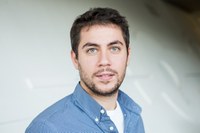 Stylianos Dimou is a Greek composer active in acoustic, electroacoustic, and acousmatic music, recognized by institutions such as the Fulbright Program, the Onassis Foundation, the Stavros Niarchos Foundation, SWR Experimentalstudio, and Cité Internationale des Arts. He studied composition at Aristotle University of Thessaloniki, the Eastman School of Music, and later completed the IRCAM Cursus in Paris. He earned his Doctoral Degree from Columbia University as a Dean’s Fellow, working with George Lewis, Fred Lerdahl, Georg Friedrich Haas, and Brad Garton.
Dimou is Associate Professor of Composition at the Grieg Academy, University of Bergen, teaching composition, music technology, electroacoustic practices, and analysis. His research focuses on performer–technology interaction, spatial immersion, and the integration of instrumental and electronic media, with particular interest in microtonal and chromatic structures.
He previously taught at the University of Peloponnese and Hong Kong Baptist University. His awards include the Ulysses Network/IRCAM Award, the Luigi Nono Prize, the Martirano Award, and the [’tactus] Young Composers Forum distinction.
Claudio Panariello
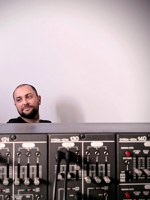 Born in Naples in 1989 and currently based in Paris, Claudio Panariello studied Composition, Electronic Music, and Piano with a parenthesis of Physics at the University of Pisa.
Working with electronics, machines, and renowned ensembles of contemporary music, his most recent artistic practice explores collaborative paradigms between artificial intelligence and human creativity, with a particular emphasis on the use of audio feedback and adaptive music systems.
He holds a PhD in Sound and Music Computing from KTH Royal Institute of Technology in Stockholm. His Doctoral Thesis is titled “Converging Creativity: Intertwining Music and Code” and can be found here.
Currently a postdoctoral researcher in the Algomus team at CRIStAL (Université de Lille, France) investigating lifelong learning for co-creative music generation, he also teaches electronic music at the bachelor and master level at the School of Electronic Music (SMET) at the Conservatory “G. Verdi” of Turin (Italy).
Ariadna Alsina Tarrés
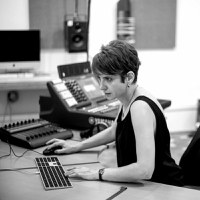 Ariadna studied violin at the Conservatori Superior del Liceu in Barcelona before completing Sonology studies at ESMUC and orienting her musical activity toward composition with L. Naón, G. Brncic, F. Pastor, and E. Resina. She simultaneously earned a degree in Art History at the Universitat Autònoma de Barcelona and a Master’s in Artistic Productions and Research (UB). She later continued her composition training in Paris with J. M. López López, H. Vaggione, A. Sedès, Ch. Groult, H. Parra, and M. Matalón. In 2015–2016 she completed the IRCAM Cursus and the Master in Mixed Music Composition at HEM Genève, studying with P. Dusapin, E. Daubresse, L. Naón, and M. Jarrell.
Her work focuses on sound malleability and timbre, spanning instrumental, mixed, electroacoustic, and interdisciplinary projects.
Her music has been performed across Europe (Manifeste, GRM, Zeppelin, Phonos, EmuFest, BFM), as well as in the USA and Chile. She completed a PhD on mixed music at Paris 8 University under Makis Solomos and Alain Bonardi. From 2019 to 2024 she was assistant in the Composition Class at HEM Genève and currently teaches in the Master in Composition with Technologies at ESMUC. She is a recipient of the Fondation Pierre Wissmer–Pulsations Contemporaines / SACEM 2025 award.