World Opera ProjectA distributed, real-time live opera performance taking place simultaneously across countries.https://www.cirmmt.org/en/research/projects/world-opera-projecthttps://www.cirmmt.org/en/research/projects/world-opera-project/@@download/image/world-opera-logo.jpeg
World Opera Project
A distributed, real-time live opera performance taking place simultaneously across countries.
The World Opera Project explores the feasibility of distributed, real-time opera performances across multiple cities in Canada, the US and Europe. It investigates how latency and technology impact emotional connection and musical synchronization. This project addresses the artistic and technical challenges of creating a global opera house in cyberspace.
Objectives
Understand the impact of audio/video delays on singers' emotional connection.
Identify strategies for coping with latency in live networked performances.
Evaluate the effect of orchestra placement on the resulting performance.
Timeline
2008-2009
Status: completed
Approach
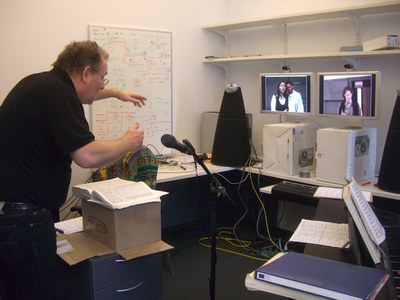
Niels Muus conducts three remote opera singers over a simulated delay network. Photo credit: Jeremy Cooperstock
Opera demands emotional expression, which becomes challenging when performers are separated by geography and time zones.
The experiments conducted were a collective effort of the Shared Reality Lab at McGill in collaboration with Niels Windfeld Lund of the University of Tromsø in Norway, the project founder.
Experiments simulated cross-country and global latencies using audio/video feeds. Vocalists, conductors, and pianists performed in separate rooms, testing delay tolerance and compensation strategies. Video display technologies such as plasma and Holo screens were also evaluated.
Outcomes & Impact
Results showed that delays often led to unwanted changes in tempo, but rehearsal helped reduce these effects. The conductor played a key role in keeping the music moving by stopping singers and the pianist from following each other, which would otherwise slow the tempo over time.
However, because delay effects were hard to judge, conductors found it difficult to make expressive adjustments. Both the conductor and pianist felt that the best way to cope with latency was to ignore the singers’ audio feed. As the conductor explained, “I do not correct because I can’t judge.”
Singers’ emotional connection was shaped more by their familiarity with the technology than by the delay itself. As they became more comfortable with the setup, distractions decreased and emotional connection increased.
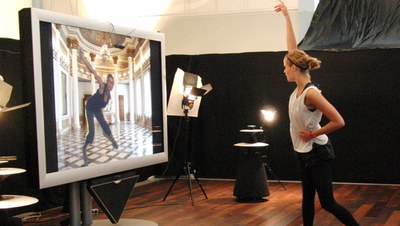
McGill researchers continued World Opera experiments at Bang & Olufsen, evaluating display technologies for stage performance, using:
conventional video projection,
Bang & Olufsen’s 103″ plasma display,
and DNP’s Holo screen.
These were tested with dancers interacting across two rooms.
Video segmentation under challenging lighting remains an active research area.
People Involved
Lead Researchers
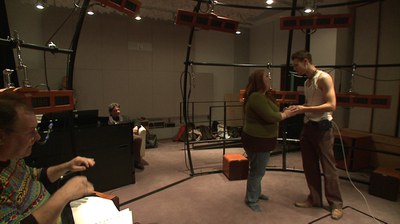
Niels Muus conducts two opera singers in a CIRMMT laboratory.
Prof. Jeremy Cooperstock, McGill University (Shared Reality Lab, CIRMMT)*