Description
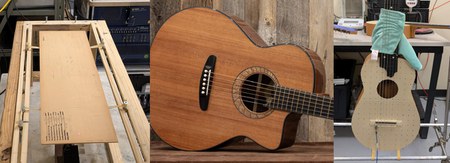
This workshop focuses on the application of scientific knowledge—specifically regarding the mechanical properties of wood, on the one hand, and the reproducibility of musical instruments, on the other—to guitar making. The workshop will compare methods for estimating the mechanical properties of wood and their direct application by a professional luthier, as well as characterize several 3D-printed guitar prototypes to assess the reproducibility of this manufacturing method.
Registration
Please fill out this MS form to register: https://forms.cloud.microsoft/r/8W3Ez5FKM4
This event is free and open to the public and will take place in person in room A832 (8 floor), Elizabeth Wirth Music Building, 527 Sherbrooke Ouest.
For those who cannot attend in person, please register in the above MS form and join via this Teams link: Workshop @ CIRMMT | Réunion-Joindre | Microsoft Teams
Progam
Raphaël Jeanvoine:
The presentation will be divided into two parts: the first will focus on methods for characterizing wood, and the second will cover the fabrication and vibrational characterization of 3D-printed guitars.
Measuring the mechanical properties of wood poses a challenge because standard methods are ill-suited for this inhomogeneous and orthotropic material. A comparison of vibrational methods for estimating Young’s modulus and the loss factor is therefore conducted, drawing conclusions regarding the use of these methods by and for luthiers.
The reproducibility of a guitar is also a major challenge for luthiers, as no two wood samples share the same mechanical properties. Consequently, the timbral behaviour of the instrument will always be unique and relatively unpredictable. The use of 3D printing is therefore justified by its presumed low variability in the manufacturing process. The presentation will focus on the characterization of three 3D-printed guitars to determine whether this hypothesis holds true.
Théo Kazourian:
My presentation will focus on implementing a simple process in the luthier’s workshop for taking measurements of the raw material and the finished instrument to characterize them, thereby making guitar construction more consistent and aligned with a specific tonal goal.
Drawing on the work of Giuliano Nicoletti, I will use a measuring setup to demonstrate this method and how it works on raw wood and on a finished instrument.
Biographies
 Raphaël Jeanvoine
A 2022 graduate of the École Nationale Supérieure d’Ingénieurs du Mans (France), specializing in vibrations and acoustics, and having earned his master’s degree in mechanical engineering from the University of Sherbrooke in 2026, Raphaël is now continuing his studies in guitar making at the Bruand workshop-school in Longueuil. An amateur guitarist with a passion for the science of sound and vibration, his master’s research topic led him to study methods for characterizing the mechanical properties of wood, applied to guitar soundboards made from Adirondack spruce (Picea rubens). He is also collaborating on a research project led by Carolina Espinoza, a Chilean researcher and lecturer at CIRMMT@UdeS: AGORA 2025. This project focuses on 3D-printed guitars with the goal of reproducing several musical instruments with similar acoustic and vibrational characteristics.
 Théo Kazourian
I specialize in crafting flat-top acoustic guitars with steel strings and jazz guitars. Crafted with great care in my workshop located within the La Corde Luthiers Collective in Montreal, I produce about four to six guitars per year. Emphasizing the quality of materials—carefully selected using both empirical and scientific methods—I employ crafting and assembly techniques that blend tradition with modernity. Choosing to work alone gives me great freedom throughout the entire manufacturing process, which is a key factor that allows me to express myself deeply through each of my instruments. I trained at the Bruand School of Guitar Making, where I am now fortunate to serve as an adjunct instructor.