The lecture will take place in Tanna Schulich Hall (enter by level 2), followed by a catered reception in the lobby of the Elizabeth Wirth Music Building. This event is free and open to the general public.
Registration
No registration is required for this event.
**CIRMMT Students wishing to have their attendance tracked for awards eligibility, please make sure to scan the QR code available at the entrance of Tanna Schulich Hall.
We invite you to share this event on Facebook.
Abstract
In recent decades, a series of cultural and technological developments have led to the recognition—even in academic circles—of Composing and Performing as relevant areas of (practice-based) Artistic Research. At the same time, creative ventures in sound and music have so much diversified that we today understand several forms of ‘sound art’ as independent from generic and consolidated notions of ‘music’ (though they often emerged from what once would have been typically considered ‘experimental music’ practices.)
In this lecture I would like to provide an overview of personal creative endeavors in which it seems to me that music-making and doing-research fed off each other to the point of sometimes becoming one.
Also, moving beyond the personal, I’d like to mention several international composers (from the last 100 years or so) whose work in fact does seem, in retrospect, to match the formal requirements of what the academia today is willing to accept as Artistic Research in Music. I argue that the last point stands in contrast to the intra-academic bias of most currently accepted genealogies of Artistic Research, and that it helps reevaluating the foundational role that today’s artist-researchers should recognize to a plurality of recent and not-so-recent trends of experimental art. I suggest that that different genealogical narrative has epistemological implications for the current and future prospects of Artistic Research in the larger social and cultural scenario (including current and future prospects of Composing and Performing).
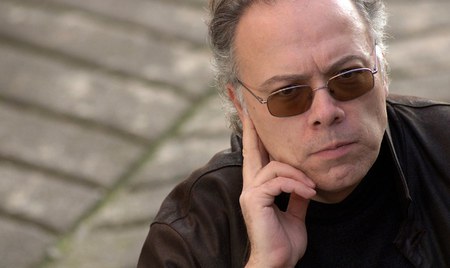
Agostino Di Scipio
Composer, sound artist, scholar, educator. Born in Naples (1962). Graduated from the Conservatory of L’Aquila. PhD from the University of Paris 8, with a practice-led research work on the notion of ‘liveness’ in highly mediatized performance. As a composer, he works in various media (computer music, chamber music, live electronics and sound installations). Central to his creative practice are original methods in the generation and transmission of sound, and the exploration of self-designed ‘man-machine-environment’ networks of sounding interactions. Artist-in-residence of several institutions worldwide, notably including the Berlin DAAD Künstlerprogramm (2004-2005). In 2011 the Galerie Mazzoli in Berlin hosted a solo exhibit of his sound installations. With pianist Ciro Longobardi, Di Scipio elaborated a full-concert realization of John Cage’s Electronic Music for Piano (Venice Biennale 2012). With saxophonist and hacktivist Mario Gabola he established a performing duo using recycled analogue circuitry. With Dario Sanfilippo he established the Machine Milieu project, exploring chaotic dynamics and autonomic behavior in multiagent systems. His output also includes three chamber music theatre works, with poetry reading plus electronics: Tiresia (with poet Giuliano Mesa), Sound & Fury (based on excerpts from Shakespeare’s The Tempest) and Umano Post Umano (with visual artist Matias Guerra). Studies focusing on Di Scipio’s oeuvre include a special issue of Contemporary Music Review (2014) and the collective volume Polveri sonore. Una prospettiva ecosistemica della composizione (La Camera Verde, Rome, 2013).
Recordings are available from various labels (RZ Edition, Neos Records, Chrysopeé Electronique, Wergo, Neuma, Stradivarius, Die Schachtel, etc.) and online streaming labels (Toxo Records, Vajero Experimental, Redshift Records, Tone List, etc.)
He served as full-time professor in Electroacoustic Composition at the Conservatory of Naples (2001-2013) and today holds the same position in L’Aquila, where he also chairs the Doctoral Program in Artistic Research in Music. Edgard-Varèse-Professor at Technische Universität, Berlin (2007-2008), visiting professor at University of Illinois Urbana-Champaign (2004), CCMIX (Paris, 2001-2007) and several other institutions, he joined various research teams in Italy and other European countries. Opening speeches at the Int’l Computer Music Conference 2013 (Perth, E. Cowan University) and the Artificial Intelligence Music Creativity Conference 2021 (TU Graz) a.o.
As a scholar and researcher, Di Scipio lectured on issues in the history, analysis and politics of sound and music technologies, and published extensively on related matters. Author of monographs such as Pensare le tecnologie del suono e della musica (Editoriale Scientifica, 2013) and Circuiti del tempo. Un percorso storico-critico sulla creatività musicale elettroacustica e informatica (LIM 2020). Guest editor of the Journal of New Music Research (special issue on Iannis Xenakis, 2002), he served as editor for various publications including Xenakis’ Universi del suono (LIM, 2003), Gottfried Michael Koenig’s Genesi e forma (Semar, 1995), Michael Eldred’s Heidegger, Hölderlin & John Cage (Semar 2000).