Sound field rendering in aircraft cabinsA joint industrial-academic project between Université de Sherbrooke, McGill University, Bombardier Aerospace, CAE and CRIAQ.https://www.cirmmt.org/en/research/projects/sound-field-aircraft-cabinshttps://www.cirmmt.org/en/research/projects/sound-field-aircraft-cabins/@@download/image/sound-field-aircraft-cabins.jpg
Sound field rendering in aircraft cabins
A joint industrial-academic project between Université de Sherbrooke, McGill University, Bombardier Aerospace, CAE and CRIAQ.
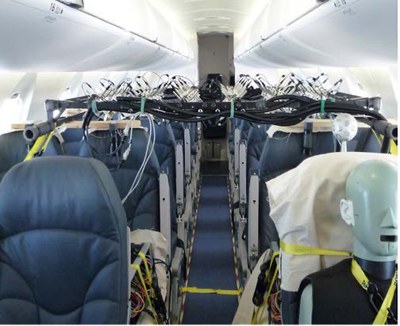
April 2012, in-flight measurements. From foreground to background: head-and-torso simulator, 32-channel spherical microphone antenna, 80-channel planar microphone antenna.
Summary
When it comes to acoustic comfort of an aircraft, usual engineering metrics do not "tell the whole story". Nothing can replace the experience of listening to the actual sound in the cabin. The project enabled the design and construction of a sound field simulator inside a full-scale model of a jet aircraft cabin.
Objectives
The objective of this project was to build an "acoustic simulator" that accurately emulates the spatial and frequency attributes of the acoustic environment of a jet aircraft cabin. The research questions concerned the hardware and software architecture of the reproduction system:
How to accurately capture the spatial sound field in the cabin of an aircraft in flight?
How to implement appropriate vibration and sound reproduction sources in the full-scale mock-up in laboratory environment?
How to create and implement signal processing algorithms for sound field reproduction?
Timeline
September 2007-March 2012
Status: complete
Approach
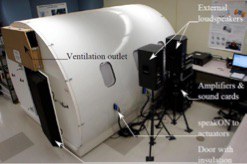
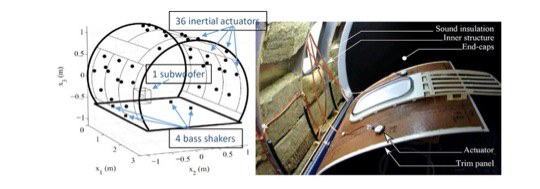
The aircraft sound simulator was implemented in a representative mock-up of a Bombardier CRJ1000 cabin, that faithfully replicates the interior of an actual CRJ1000 cabin.Exterior view of the CRJ1000 mock-up in the Sherbrooke laboratory.
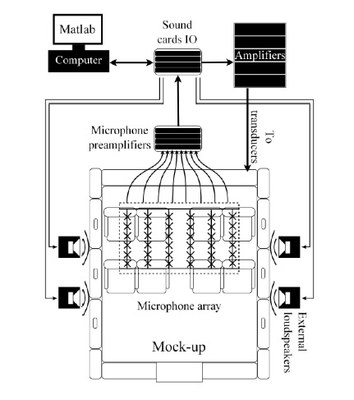
The virtual sound field was created by an array of over 40 small vibration actuators placed either on the floor or behind the composite trim panels (therefore invisible to a listener in the mock-up); in addition, the low-frequency floor and seat vibration, which is an essential component of the vibro-acoustic experience of an aircraft cabin was also partly reproduced in the mock-up.
An essential component of the project was to capture the spatial and frequency attributes of the actual sound field of the aircraft in various flight conditions; this information was to be used as the "target" for our sound reproduction system in the mock-up. This task was accomplished with a 96-microphone antenna (specially built for this purpose) that spatially sampled the aircraft sound field. Dedicated sound field extrapolation algorithms were used to create an "image" of the complete cabin sound field from the measurements at microphone locations in-flight.
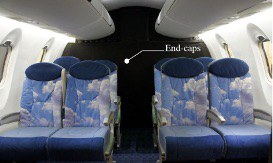
Also, the "brain" of the acoustic simulator had to make sure that the array of reproduction sources were driven so as to exactly recreate identical sound fields at identical microphone locations in the actual aircraft and in the mock-up. This part of the system was implemented via multi-channel equalization algorithms and signal processing.Interior view of the CRJ1000 mock-up in the Sherbrooke laboratory.
Finally, the accuracy of the sound reproduction system was established by a series of objective and subjective measurements. The objective measurements consisted in a comparison of the target and reproduced sound pressure at a number of locations in the mock-up. The subjective tests demonstrated that human listeners placed in the mock-up were not able to hear the difference between actual aircraft sounds and an artificial reproduction of these sounds using the simulator.
Outcomes & Impact
The outcome of the project is methodology, software and hardware for experimental sound field rendering of aircraft cabins and cockpits.
The systems developed provide both marketing and engineering design tools to help aircraft companies advertise and improve the acoustic comfort of their business jet aircraft.
This platform can be used to provide a systematic evaluation of human responses within the virtual environment and derive subjective metrics of acoustic comfort in aircraft cabins.
Although the project looked at a specific application to aircraft cabin noise, most aspects of the approach can be applied to vehicle noise in general or occupational noise.
People Involved
Lead researchers: Alain Berry (Sherbrooke)*, Catherine Guastavino (McGill)*
Research professionals: Philippe-Aubert Gauthier (Sherbrooke)*, Yann Pasco (Sherbrooke)*, Julien Boissinot (McGill)*, Patrick Lévesque (Sherbrooke)
Postdocs and students: Cédric Camier (Sherbrooke)*, Ilja Frissen (McGill)*, Charles Verron (McGill)*, Jennifer Langlois (McGill)*, Éric Chambatte (Sherbrooke), Félix-Antoine Lebel (Sherbrooke)
*CIRMMT Regular, Collaborator or student members and staff
Selected Refereed Journal Articles, Accepted or Published
Sound field reproduction system
O. VALENTIN, P.-A. GAUTHIER, C. CAMIER, Y. PASCO, A. BERRY, C. GUASTAVINO, C. VERRON. (2022). Perceptual validation of sound environment reproduction inside an aircraft mock-up. Applied Ergonomics. 98.
P.-A. GAUTHIER, C. CAMIER*, F.-A. LEBEL*, Y. PASCO, A. BERRY, J. LANGLOIS*, C. VERRON*, C. GUASTAVINO. (2016). Experiments of multichannel least-square methods for sound field reproduction inside aircraft mock-up: Objective evaluations. J. Sound and Vibration. 374 (194-216).
P.-A. GAUTHIER, C. CAMIER*, T. PADOIS*, O. GAUTHIER*, Y. PASCO, A. BERRY. (2015). Sound field reproduction of real flight recordings in aircraft cabin mock-up. AES: Journal of the Audio Engineering Society. 63(1-2): 6-20.
FRISSEN, I., ZIAT, M., CAMPION, G., HAYWARD, V., & GUASTAVINO, C. (2012). “The effect of voluntary movements on auditory-haptic and haptic-haptic temporal order judgments.” Acta Psychologica, 141, 140-148.
FÉRON, F-X., FRISSEN, I., BOISSINOT, J., & GUASTAVINO, C. (2012). “Upper limits of auditory rotational motion”. Journal of the Acoustical Society of America, 128(6), 3703-3714.
Selected Conference Presentations and Posters
A. BERRY, P.-A. GAUTHIER. (2016). Spatial reproduction of aircraft cabin noise in a full-scale mockup. InterNoise 2016, Hamburg, Germany
P.-A. GAUTHIER, C. CAMIER*, T. PADOIS*, O. GAUTHIER*, Y. PASCO, A. BERRY. (2013). Objective Evaluation of Sound Field and Sound Environment Reproduction in Aircraft Mock-Ups Using Acoustic Imaging, AES 52nd International Conference , Sound Field Control, Surrey, U.K.
C. VERRON, P.-A. GAUTHIER, J. LANGLOIS, C. GUASTAVINO, (2011). « Binaural Analysis/Synthesis of interior aircraft sounds”, 2011 IEEE Workshop on Applications of Signal Processing to Audio and Acoustics, New Paltz, NY, October 16-19, 2011.
J.LANGLOIS, C. VERRON, P.-A. GAUTHIER, C. GUASTAVINO, (2011). “Perceptual evaluation of interior aircraft sound models”, 2011 IEEE Workshop on Applications of Signal Processing to Audio and Acoustics, New Paltz, NY, October 16-19, 2011.
P.-A. GAUTHIER, C. CAMIER, Y. PASCO, E. CHAMBATTE, A. BERRY, (2010). “Sound field extrapolation: Inverse problems, virtual microphone arrays and spatial filters”, AES 40th INTERNATIONAL CONFERENCE, Tokyo, Japan, October 8–10, 2010.
BERRY, C. GUASTAVINO, R. LAPOINTE, M.-A. DELALAY, J. BOISSINOT, C. CAMIER, É. CHAMBATTE, I. FRISSEN, P.-A. GAUTHIER, D. LANGLOIS, J. LANGLOIS, F.-A. LEBEL, Y. PASCO, C. VERRON, (2012) « Reproduction du champ sonore dans les cabines d’avions », poster presented during DESTINATION/2022, CRIAQ 10th anniversary, May 2012 (received best poster award).
PRAS, A., CORTEEL, E., & GUASTAVINO, C. (2009). “Qualitative evaluation of Wave Field Synthesis with expert listeners.” Invited paper at the NAG-DAGA International Conference on Acoustics. Rotterdam, The Netherlands, 2009.