Speech Production in Challenging Listening Conditions
Noise, Ear Occlusion, Hearing Impairment, and Speech Production
Return to the Projects main page
Summary
This project investigates how noise, ear occlusion, and hearing impairment shape speech production by altering self-auditory feedback. By developing and analyzing the Hearing-Integrated Bilingual Speech Corpus (HIBiSCus), the project provides new insights into speech motor control and supports innovations in hearables, audiology, and speech communication research.
Objectives
- Characterize how noise, ear occlusion, and hearing thresholds—individually and together—affect speech production.
- Develop the HIBiSCus corpus, a bilingual (English–French) speech database collected across different noise and ear occlusion conditions for various speech-rated tasks.
- Examine individual variability in the effect of noise, ear occlusion, and hearing threshold on speech level.
- Advance understanding of how hearing impairment influences speech level and its adaptation in different noise and ear occlusion conditions.
- Provide high-quality multimicrophone speech recordings for cross-disciplinary research on communication, hearing health, and hearables.
Timeline
| 2021 September | Start of project |
| 2024 June-December | Data collection |
| 2025 January-April | Data cleaning and analysis |
| 2025 May-August | Database and analysis on speech level: journal article written, with acceptance pending minor revision received in 2025 October. |
| Ongoing | Further analyses |
Approach
The methodology integrates experiments, corpus development, and statistical analysis:
- Speech was recorded in controlled acoustic conditions within an audiometric booth using multiple microphones (reference, in-ear, outer-ear).
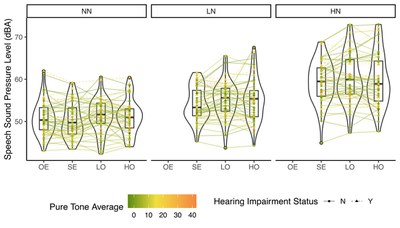
- Listening conditions systematically varied across three noise levels (silent, 70, 85 dBA) and four ear occlusion states (open, simulated open, low occlusion, high occlusion).
- Participants performed three tasks: reading sentences, sustained vowel production, and picture description.
- Audiometric pure-tone hearing thresholds were measured to allow continuous modelling of hearing impairment.
- Linear mixed-effects modelling was used to evaluate how noise, occlusion, and hearing thresholds influence speech level and adaptation patterns.
Outcomes & Impact
- Creation of HIBiSCus, a French-English speech corpus examining noise, occlusion, and hearing thresholds together.
- New evidence on how hearing thresholds modulates the effect of noise and ear occlusion on speech level control.
- Insights supporting improved design of hearables, hearing aids, and communication technologies.
- Contributions to theories of speech motor control and auditory-feedback mechanisms.
- Open-access database enabling cross-disciplinary collaborations involving acoustics, audiology, speech science, and engineering.
People Involved
- Xinyi Zhang — Lead Researcher / PhD Student*
- Dr. Rachel Bouserhal — Supervisor (ÉTS, CIRMMT)*
- Dr. Ingrid Verduyckt — Co-investigator (Université de Montréal)
*CIRMMT Regular and student members
Partners
- The Research in Hearing Health and Assistive Devices (RHAD) Lab
- Centre for Interdisciplinary Research in Music, Media and Technology (CIRMMT)
- École de technologie supérieure (ÉTS)
- Université de Montréal — École d’orthophonie et d’audiologie
Granting Agencies / Funding Sponsors
- Natural Sciences and Engineering Research Council of Canada (NSERC - Discovery grant)
- Fonds de recherche du Québec's Master's training scholarship
- CIRMMT student award 2024-25
- ETS Marcelle Gauvreau Engineering Research Chair in Multimodal Health Monitoring and Early Disease Detection with Hearables
Resources
- Published paper: "Hearing-integrated bilingual speech corpus: a French-English corpus including hearables for studying speech production under challenging listening conditions". https://doi.org/10.1121/10.0042355
- Hearing-Integrated Bilingual Speech Corpus (HIBiSCus)
Keywords
Scientific/technological research, Speech production, Noise & ear occlusion, Hearing impairment, Auditory feedback
Learn More
- RHAD Lab website
- Google Scholar
- ORCiD
- LinkedIn Xinyi Zhang