The lecture will take place in Tanna Schulich Hall (enter by level 2), followed by a catered reception in the lobby of the Elizabeth Wirth Music Building. This event is free and open to the general public.
Registration
No registration is required for this event.
**CIRMMT Students wishing to have their attendance tracked for awards eligibility, please make sure to scan the QR code available at the entrance of Tanna Schulich Hall.
We invite you to share this event on Facebook.
Abstract
For many years, my research has focused on how machine learning can better support fundamentally human creative activities in music and art. Working closely with creators—including musicians, instrument designers, artists, and children—has shown me that creative practice requires us to think differently about what ML is good for, how data functions within today's AI systems, and how to build ML tools for creative and critical uses. For instance, I'll discuss how ML can foster embodied engagement in design, expand who can participate in creative practices with technology, and underpin completely new types of creative work. Along the way, I'll show how creative practices with ML invite us to understand training data as an expression of choices, priorities, and values—and how working with data and models can challenge, surprise, and ultimately change us.
Biography
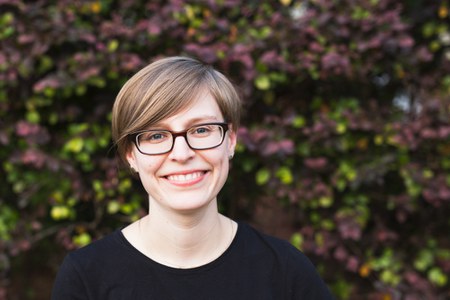
Rebecca Fiebrink is a Professor of Creative Computing at the UAL Creative Computing Institute. Together with her students and research assistants, she works on a variety of projects developing new technologies to enable new forms of human expression, creativity, and embodied interaction. Much of her research combines techniques from human-computer interaction, machine learning, and signal processing to allow people to apply machine learning more effectively to new problems, such as the design of new digital musical instruments and gestural interfaces for gaming and accessibility. She has also been involved in projects developing rich interactive technologies for digital humanities scholarship, exploring ways that machine learning can be used and appropriated to reveal and challenge patterns of bias and inequality, and advancing creative machine learning education. Professor Fiebrink has frequently worked with organisations outside academia, spanning industry research labs, design studios, community music organisations, and creative industries start-ups and funders. She holds a PhD in Computer Science from Princeton University, and she is happy to be returning to McGill, where she received a Masters in Music Technology in 2004.