
SynchMuse
Computational models of musical synchrony in human-agent groups
Return to the main Project page
Summary
In the proposed project, we investigate the combined use of computational modelling and adaptive virtual agents to gain deeper insights into the control principles of human temporal synchronization. We explore adaptive artificial agents, and their virtual embodiment, in their potential to develop novel musical performance practices.
Objectives
- Gain deeper knowledge on group synchronization in musical ensembles.
- Develop computational modeling of group synchrony based on collected behavioral data.
- Create autonomous and embodied virtual agents that simulate human-like synchronization dynamics in a human musical ensemble.
Timeline
2024-2027
Status: In progress
Approach
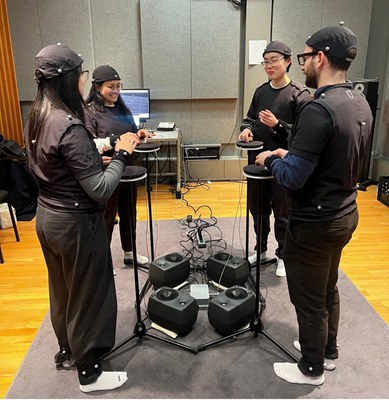 In a first experiment, participants performed drumming tasks in simple (isochrony) and complex (2:3 polyrhythms) rhythms in a quartet.
- Computational modeling of group synchronization behaviors was developed based on the collected data.
- Evaluation of computational models of group synchrony implemented in adaptive virtual agents by testing them in human-agent ensemble groups.
Outcomes & impact
- Creation of virtual musical agents for performance practices and audience experiences.
- Contributions to the theories of dynamical systems in human temporal synchronization.
- Advancements in computational modeling of synchrony in large musical groups.
- Innovating musical practices in the cultural-creative sector.
People involved
- Marcelo M. Wanderley, McGill University*
- Caroline Palmer, McGill University*
- Pieter-Jan Maes, Ghent University
- Bart Moens, Ghent University
- Bavo Van Kerrebroeck, Ghent University*
- Davide Lionetti, Ghent University
- Chihiro Honda, McGill University*
Partners

Granting agencies / Funding sponors
- Fonds de recherche du Québec – Nature et technologies (FRQNT; grant 356152),
- Research Foundation – Flanders (FWO; grant G0AER24N)
Resources
Publication
- Submitted: “Subgroup Relationships and Individual Differences in Musical Synchronization”
Keywords
- Group musical synchronisation; embodied virtual agents; computational modeling; social interaction
Media
Opportunities for Engagement
- Presentation at the CIRMMT Workshop: Real and Virtual Acoustic Spaces and Their Occupants (January 2026)
- Presentation at Society for Music Perception and Cognition (July 2026)
- Co-creation workshop (June 2026)